
This post may contain affiliate links, which means I may receive a small commission, at no additional cost to you, if you purchase through these links. See my full disclosure here.
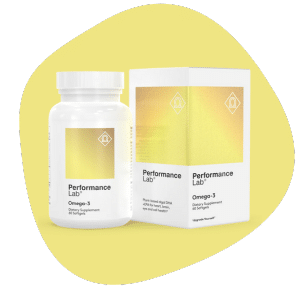
Performance Lab put together an alternative to fish oil supplements to offset potential issues such as heavy metals and contaminants, and the eco-destructive consequences of excessive fish exploitation.
While doing that, they consequently put forward a solution for vegans and vegetarians who are unable to consume fish.
This product, formulated in the United Kingdom and manufactured in the United States by Opti-Nutra, is rather high-end when compared to other supplements on the market.
It contains algae oil from Life’s Omega 60, which is claimed to be 85% more potent than fish oil, and is deemed a sustainable plant-based form that doesn’t negatively impact the marine ecosystem.
I found this product to be an innovative and potent solution for anyone looking to avoid fish oil supplements, but it comes at a price since it’s not the most affordable out there.
Main Takeaways
- Performance Lab Omega 3 packs a punch with 2000mg of Omega-3 fatty acids in two pills, including 600mg of DHA and 300mg of EPA. This is a higher dose compared to many other supplements out there.
- The algae used in this formula grows indoors in a state-of-the-art facility, and this setup ensures there’s no stuff like mercury, heavy metals, or any other nasty chemicals in the end product.
- The flip side to this safety and quality control comes at a price. It’s about $39 for a month’s supply, which is not easy to shell out for a supplement.
Performance Lab Omega 3 Nutrition
There are 11 different types of Omega-3 fatty acids, but the three most important ones are alpha-linolenic acid (ALA), eicosapentaenoic acid (EPA), and docosahexaenoic acid (DHA).
In a two-pill serving of Performance Lab Omega 3, there are 2000mg of Omega-3 fatty acids, of which 600mg correspond to DHA and 300mg to EPA. We’ve looked at many different Omega-3 supplements, and this supplement contains a comparatively higher dosage of DHA and EPA than other supplements.
Some health organizations claim that you should take at least 250–500 mg of combined DHA and EPA each day, particularly if you are a healthy adult. (1, 2, 3)
In spite of the recommendations put forward by health organizations, a general consensus about how much omega-3s a person should consume per day is not yet established. There are many variables that contribute to an individual’s omega-3 status, which makes it difficult to estimate the optimal amount of DHA and EPA.
Performance Lab Omega 3 has a combined 900mg of DHA and EPA, which is obviously above what health organizations recommend, but that isn’t necessarily a bad thing.
Even though historically researchers have used smaller doses of EPA and DHA, higher amounts are often used for certain health conditions such as heart disease, depression, and cancer.
However, there isn’t a consensus on whether higher doses really benefit those conditions.
The nutrients are encased in vegan-friendly soft-gel capsules made from modified tapioca starch, glycerin, and purified water and the product itself is non-GMO, free from gluten and soy, and GMP certified.
[See our complete guide for the best alternatives for fish oil supplements]
Performance Lab Omega 3 Benefits & Effectiveness
This product offers a relatively high dose of omega-3 fatty acids, delivered in an optimal 2:1 ratio of DHA and EPA, so its effectiveness for raising omega-3 levels is second to none.
Omega-3 supplements are produced for the same purpose, which is to raise omega-3 levels, so the benefits for this or a different supplement doesn’t differ unless the manufacturer adds other components.
In America, 10% of adults take an omega-3 supplement, despite not being certain whether these products truly live up to their claims.
Well, a large multistudy with 25,871 healthy adults with no history of cardiovascular disease and at risk for it, and the group was racially diverse and representative of the general population. In this study, they tested whether a moderate 1-gram dose could help prevent major cardiovascular events, compared with a placebo. (4)
The findings of the study are complex because the supplement didn’t protect most healthy people against future heart problems. However, those eating less than 1.5 servings of fish a week or didn’t eat fish at all, experienced a 19% reduction in the primary endpoint of major cardiovascular events, with a 40% reduction in heart attacks.
The supplements also benefited African American participants, who saw a 77% reduction in heart attacks, though, they couldn’t pinpoint why that was the case.
In other words, if you’re someone that eats very little fish or is an African American, you may benefit from an omega-3 supplement, particularly one with 1g or more of omega-3 fatty acids.
Another large study with 8,179 middle-aged men and women who had high triglyceride levels and risk factors for heart disease or had already experienced a heart attack, stroke, or cardiovascular event was also conducted. It aimed to find out if a daily high-dose (4 grams) of omega-3 medication could protect participants against future cardiovascular events, compared with a placebo. (5)
The results reveal that omega-3 medication protected high-risk individuals from cardiovascular events, so those taking omega-3 had 25% less likely to die from heart disease or to have a heart attack or stroke.
Thus, if you’re an individual within this risk group, you may benefit from taking this omega-3 supplement, even though they used an unusually large dose of omega-3 fatty acids in the study.
[See our article on some of the best fat sources for a healthy vegan diet]
Performance Lab Omega 3 Price
One bottle is $39 for a month’s supply. That is roughly $1.30 per serving.
For a supplement with a high-dose of omega-3 per serving, I found it to be reasonably priced, particularly when you learn that the company grows the algae indoors in a state-of-the-art facility, which means they can also guarantee that you won’t come across mercury, heavy metals, PCBs, or toxic contaminants. Plus, algae is not the cheapest ingredient, and that is reflected in the price.
For many people, $39 for a bottle of omega-3 might be too much, so you’re free to choose a cheaper alterna